
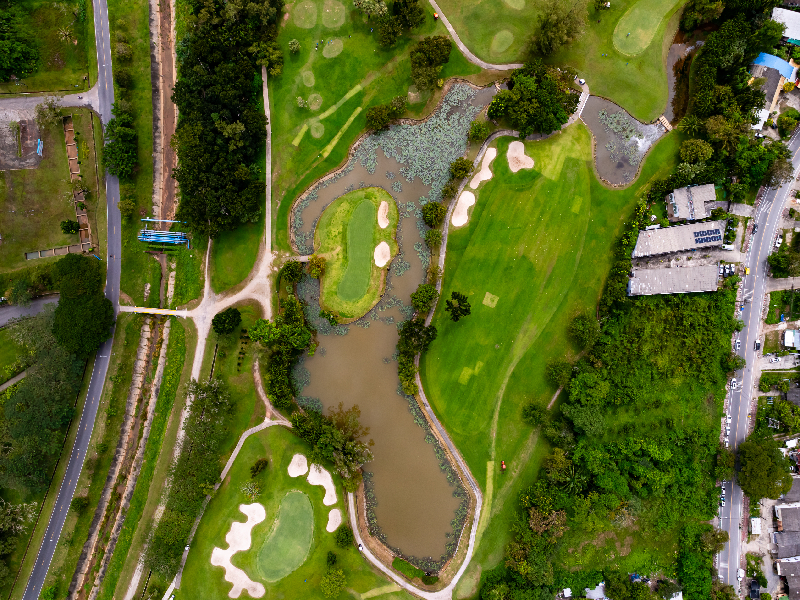
In the tropical climates of Southeast Asia, the monsoon season often dictates the operational success of a sports facility. At Golf Design India (GDI), we believe that the secret to year-round playability is to stop fighting the rain and start working with it. As a premier golf architecture & construction firm, GDI utilizes the land’s original topography to create self-draining landscapes. Under the technical vision of Vijit, our golf course design architect approach prioritizes natural flow over mechanical force. By mapping natural hydrological pathways, a golf design architect can ensure that water is whisked away from playing surfaces instantly. Furthermore, as an expert golf course audit firm, we identify where traditional drainage systems fail and provide modern, nature-based retrofits. Our dedicated golf design india team specializes in turning high-rainfall challenges into strategic assets like retention lakes and bioswales. By choosing a design that respects the land’s rhythm, owners can ensure their course remains open while others are forced to close. This blog explores how GDI’s “Design Dictated by Nature” philosophy creates a weather-resilient masterpiece that stands the test of time.
For many years, the standard response to heavy rainfall in golf development was to fight it using massive industrial pumps and artificial grading . At Golf Design India (GDI), we have shifted this paradigm by adopting a “nature-first” engineering philosophy that views rain as a resource rather than an enemy. Our lead golf design architect, Vijit, emphasizes that a course should mimic the land’s original hydrological rhythm. By understanding and feeling the land before construction, we can identify exactly how water wants to move . This allows us to create fairways and greens that shed water naturally, preventing the saturation that leads to closed courses. We believe that the creations of nature cannot be emulated by man, so we integrate them into our strategy. This approach creates a seamless playing experience that feels authentic to the local climate.
The most successful drainage system is one that uses gravity as its primary engine, requiring zero electricity or mechanical maintenance . Within the field of golf course architecture, this requires a high level of topographical intelligence and precision mapping. The golf design india team meticulously analyzes every ridge and valley on a site to determine the most efficient pathways for surface runoff . By aligning fairways with these natural valley lines, we ensure that water moves rapidly toward collection points . This “Natural Flow Integration” is what allows our courses, like the one in the Kharghar Valley, to remain playable just hours after a downpour . Utilizing existing slopes reduces the need for carbon-heavy earthmoving and preserves the site’s unique character . This blend of engineering and ecology is what defines a modern GDI masterpiece.
A professional golf course design architect must think like a hydrologist, envisioning how thousands of gallons of water will behave on a single green . At GDI, Vijit ensures that every undulation serves a dual purpose: providing a strategic challenge for the golfer and a drainage pathway for the rain. We design greens with subtle “exit points” that prevent water from pooling in the center, which is critical for maintaining turf health. Our golf design architect philosophy also involves the use of specialized sub-surface layers that promote rapid vertical drainage. This ensures that even during a tropical storm, the rootzone remains oxygenated and the surface remains firm. By balancing these technical requirements with the aesthetic beauty of the course, we create facilities that are both stunning and functional. It is this attention to detail that earns GDI its reputation as India’s premiere architecture firm .
When our team operates as a golf course audit firm, the first thing we examine is the facility’s ability to recover from a significant weather event . We have found that courses relying solely on artificial piping often suffer from “drainage fatigue” as pipes clog or pumps fail over time . A natural drainage system, however, is much more resilient and requires significantly less capital for long-term repairs. Our audits provide management with a well-structured review of how they can retroactively apply natural flow principles to their existing layout . By identifying areas of localized waterlogging, we can suggest minor topographical adjustments that provide major operational improvements. This data-driven approach helps owners reduce their maintenance budgets while improving the overall player experience. An audit is not just about finding problems; it is about finding sustainable solutions for the future.
In the GDI vision, every drop of rain that falls on the course is a valuable asset that should be harvested for later use . Our golf course design architect team specializes in creating retention lakes that serve as high-capacity reservoirs during the monsoon season. These lakes are strategically placed at the lowest points of the natural drainage network, allowing them to collect runoff without the need for energy-intensive pumping. During the dry summer months, this stored water becomes the primary source for irrigation, creating a truly sustainable, closed-loop water cycle. This approach is particularly effective in high-rainfall zones like the Western Ghats or the Nilgiri Hills . By integrating these lakes into the strategy of the course, we provide golfers with beautiful water hazards that are also critical pieces of infrastructure. This is how we strike the finest balance between budgets, scale, and environmental opportunity .
The longevity of a weather-resilient course depends on the precision of its construction and the quality of the materials used . As a leading golf architecture & construction firm, GDI utilizes advanced shaping techniques to ensure that all surface contours are exactly as designed. We also implement specialized methods like the “Better Billy Bunker” system to protect hazards from erosion and sand contamination during heavy storms. This involves a polymer-treated gravel layer that allows water to pass through the bunker sand instantly while keeping the sand in place. Our dedicated golf design india team of engineers and shapers works tirelessly to ensure that every sub-surface pipe and drainage basin is installed to international standards . This meticulous approach to construction is what allows GDI courses to outlast those built with traditional methods. We build for performance, ensuring that the course remains an asset regardless of the season.
Golf Design India (GDI) is a multi-award-winning firm based in New Delhi, recognized as the most awarded in the country . Under the leadership of Vijit, the first certified golf architect in India with a degree from Scotland, we have set a new standard for excellence . Our brand USP is the seamless integration of technical engineering with a “Design Dictated by Nature” philosophy. We take pride in delivering iconic projects that receive international acclaim for their beauty and operational efficiency . From the complete redevelopment of historic clubs like RCGC to the creation of massive new townships, our pedigree is unmatched . GDI is committed to building sustainable golf environments that provide a unique playing experience for every golfer. We don’t just design courses; we craft legacies in green.
GDI offers a comprehensive spectrum of services, from initial feasibility analysis to long-term operations management . Our team of experts includes horticulturists, turf specialists, and irrigation engineers who ensure that every project is environmentally responsible. We specialize in creating adaptable designs for varied land types, including executive courses, practice academies, and full championship venues . Our passion is reflected in our active involvement in every stage of development, ensuring precision and performance . By choosing GDI, clients partner with a firm that understands the complexities of the Indian climate and the requirements of global golf standards. We continue to strive for innovation, ensuring that every course we create is a benchmark for sustainable development in the industry.
Natural topography allows a designer to use gravity as the primary force for moving water, rather than relying on electrical pumps. By identifying the land’s existing ridges and valleys, the course can be routed so that water naturally flows off the playing surfaces and into collection areas. This approach prevents waterlogging by ensuring that water never has a chance to pool in low spots on the fairways or greens. It also reduces the need for extensive artificial grading, which can be expensive and harmful to the local soil structure. Ultimately, a topography-based design is more resilient to extreme weather and requires less maintenance than a purely artificial system.
The designer’s role is to integrate sophisticated hydrological engineering with the strategic layout of the course to ensure peak performance during heavy rains. This includes shaping the greens and fairways with subtle exit points that guide water away from critical playing areas without affecting the golfer’s experience. The architect must also design a network of retention ponds and bioswales that can handle high volumes of runoff instantly. By planning for “worst-case” rainfall scenarios during the ideation phase, the architect ensures the facility’s long-term operational success. This proactive approach allows the course to recover quickly, protecting both the turf and the club’s revenue.
An audit firm provides an objective, data-driven assessment of why a course’s current infrastructure is failing to manage water effectively. By using tools like sub-surface imaging and moisture mapping, auditors can find clogs, pipe collapses, or topographical “dead zones” that are not visible to the naked eye. This professional review allows management to target their limited repair budgets at the root causes of waterlogging rather than just treating the surface symptoms. Auditors can also suggest modern retrofitting techniques that can be implemented with minimal disruption to daily play. Their specialized expertise ensures that drainage improvements are both effective and sustainable for the future.
A professional firm designs the entire landscape to act as a giant funnel that directs rainwater into a series of interconnected storage reservoirs. These reservoirs are often designed as beautiful lake features that also serve as high-capacity catchments during heavy storms. This harvested water is then filtered and stored for use during dry periods, significantly reducing the facility’s reliance on municipal water or local groundwater. This practice is essential for creating an environmentally responsible and economically viable business model in regions with seasonal rainfall. It ensures that the course remains lush and green year-round without putting a strain on the local community’s water resources.
Multiple tee boxes ensure that the course is accessible and enjoyable for golfers of every ability, from high-handicappers to professional athletes. By providing different starting distances, the design ensures that every player can reach the fairway in regulation and experience the strategic “intent” of each hole. This inclusivity is critical for growing the game and ensuring that the facility appeals to a broad demographic of players. It also improves the “pace of play” by reducing the number of lost balls and difficult shots for less experienced golfers. A course that accommodates everyone is more likely to thrive as a successful and welcoming community asset.